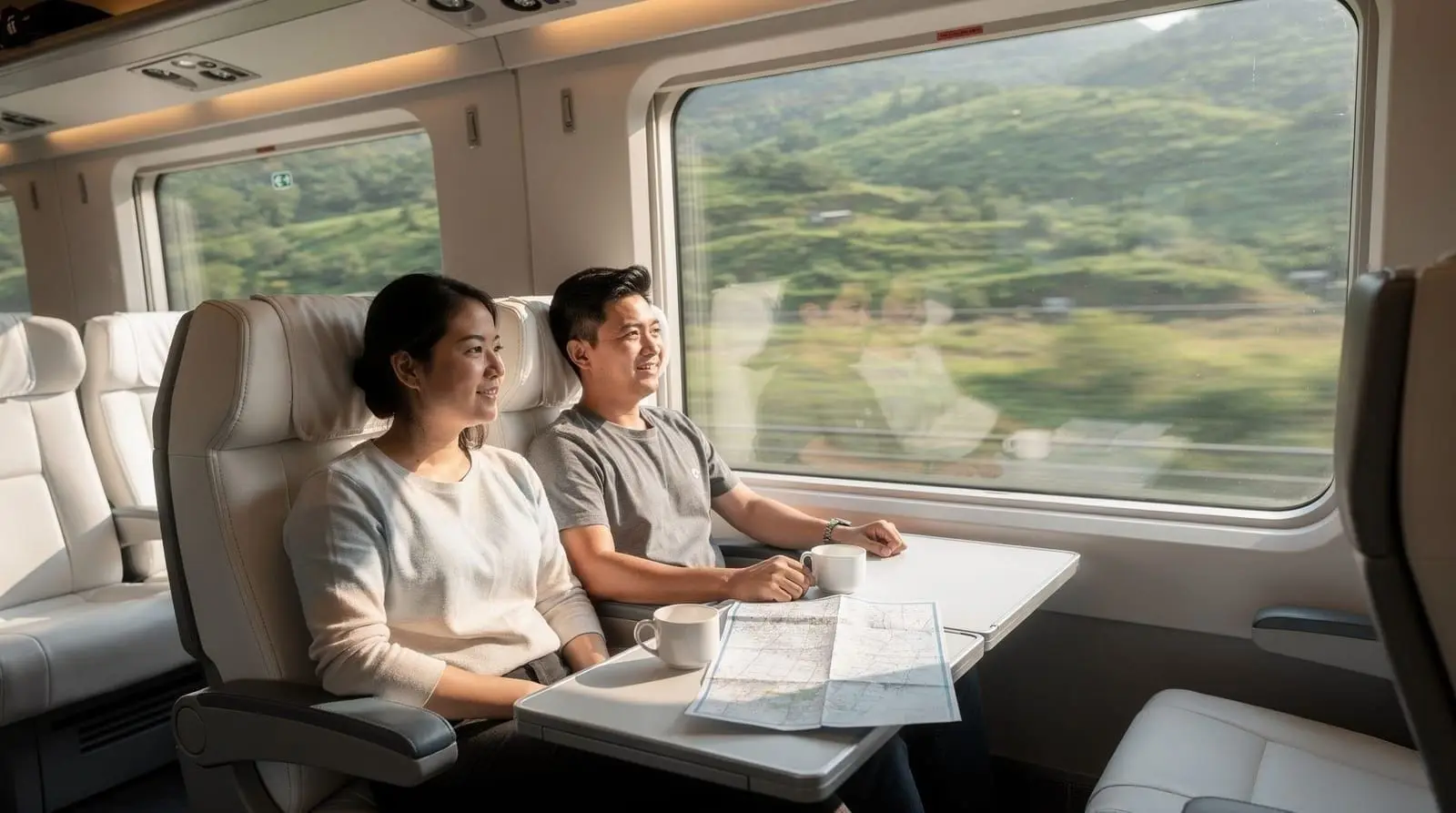
The Greater Bay Area on the high-speed rail: a practical loop guide
The Greater Bay Area — Hong Kong, Macau, Shenzhen, Guangzhou, Zhuhai, Foshan, Dongguan, and several smaller cities — is now one of the best-connected urban regions in the world by rail. Understanding the rail network changes how you plan a multi-city trip. What might look like a complicated loop on a map becomes a day trip when the journey time is 14 minutes (Hong Kong to Shenzhen Futian by HSR) or 47 minutes (Hong Kong to Guangzhou South).
| Where | Hong Kong ↔ Shenzhen ↔ Guangzhou ↔ Zhuhai |
| Cost | Around HKD 280–380 return, HK–Guangzhou second class |
| Time needed | 14–47 min per leg; a full loop fits comfortably in 5 days |
| Booking | 12306.cn, Trip.com, or West Kowloon station machines |
| Best for | Multi-city trips without renting a car or flying |
For the road/bridge alternative between Hong Kong and Zhuhai or Macau, see the HZMB bridge guide; for the wider Shenzhen vs Hong Kong decision, see that comparison.
The three main rail routes
Hong Kong West Kowloon ↔ Shenzhen Futian / Shenzhen North
This is the Guangzhou–Shenzhen–Hong Kong Express Rail Link (XRL), operated jointly. From Hong Kong West Kowloon station (Kowloon, directly above the MTR station), trains run north into Guangdong province with stops at Shenzhen Futian (14 min from HK), Shenzhen North (23 min), and continuing to Guangzhou South (47 min). The line continues to other mainland cities.
This corridor is genuinely transformative. Hong Kong to Guangzhou in 47 minutes means that what was previously a 90-minute express train journey is now the time it takes to have a coffee. For travellers, it opens Guangzhou as a day trip from Hong Kong — or, more interestingly, makes a multi-day loop natural: sleep in Hong Kong, spend a day in Guangzhou, cross to Shenzhen for a night, return via metro.
Shenzhen North ↔ Guangzhou South (local CRH services)
For travellers already in Shenzhen, Shenzhen North station (well-connected to Shenzhen metro) has frequent CRH (China high-speed) trains to Guangzhou South. Journey time: approximately 30–40 minutes. Frequency: every 10–20 minutes during peak times. Second-class fare: CNY 75–90 (~USD 10–13).
Guangzhou ↔ Zhuhai (Intercity Rail)
The Guangzhou–Zhuhai Intercity Rail connects Guangzhou South to Zhuhai in approximately 75–90 minutes. Zhuhai is also accessible from Hong Kong via the HZMB (see our HZMB bridge guide), but the rail option is cheaper and more comfortable for travellers already on the mainland.
Booking tickets
Between Hong Kong and mainland China (XRL)
Tickets can be booked at Hong Kong West Kowloon station (walk-in or self-service machines), on the MTR HK app (which has expanded to cover cross-boundary rail), or via the 12306.cn platform (China’s official rail booking site) with an international credit card. The 12306 site has an English interface that is functional. Alternatively, third-party services like Trip.com (formerly Ctrip) handle the booking in English more smoothly.
Note: Cross-boundary tickets require passport information at the time of booking. The ticket price varies slightly by time of day; early morning and late evening trains can be marginally cheaper.
Second-class return from HK to Guangzhou South: approximately HKD 280–380 (~USD 36–49) depending on the date.
Within mainland China (CRH)
Book on 12306.cn or Trip.com using your passport as ID. Payment can be made by international Visa/Mastercard on 12306 (this was added as a feature in 2024 and now works reliably) or via Alipay on Trip.com. You can also buy at station ticket windows with your passport — queue times at Shenzhen North are typically 5–15 minutes outside peak periods.
Tickets for popular routes (Hong Kong-Guangzhou, especially weekend and holiday) sell out in advance. Book 2–3 days ahead at minimum.
The immigration process at West Kowloon
West Kowloon station has a co-located immigration arrangement that is worth understanding. When travelling from Hong Kong to the mainland, you clear both Hong Kong exit immigration and Chinese entry immigration at West Kowloon before boarding. This means you are technically in mainland Chinese territory within the Hong Kong station — immigration is completed before you reach Shenzhen or Guangzhou.
Arriving from the mainland at West Kowloon: you clear Chinese exit and Hong Kong entry immigration at West Kowloon upon arrival, before exiting to the MTR.
The process is smooth and well-organised. Allow 30–40 minutes before your departure if queues are light; 60 minutes on busy weekends and public holidays.
Guangzhou South station: getting into the city
Guangzhou South (广州南站) is a large HSR hub that handles enormous passenger volumes. It is well organised but requires knowing your onward connection.
From Guangzhou South to central Guangzhou: Metro Line 2 connects Guangzhou South to Yuexiu Park (near the old city centre) in about 30–35 minutes. CNY 8 (~USD 1.10). The metro connection is direct from the station arrivals level — follow signs to Line 2.
From Guangzhou South to Tianhe (CBD area): Metro Line 7 to Tianhe, approximately 35–40 minutes.
The station itself is several kilometres south of the urban core, so don’t plan to walk into the city. Taxis and DiDi are also available at the designated ground-floor pick-up points.
For a Guangzhou day trip from Hong Kong or Shenzhen, a sensible loop is: morning train to Guangzhou South → metro to Yuexiu/Xiguan old city area → afternoon at Canton Tower or Pearl River area → evening return train. See the Guangzhou destination page and the Guangzhou in 2 days guide for what to prioritise, and the Canton Tower guide for that specific stop.
If you’d rather have a guide handle the logistics across cities on your first loop:
Book a 3-day guided tour covering Guangzhou, Zhuhai, and ShenzhenShenzhen North vs Shenzhen Futian: which station to use
Shenzhen North (深圳北站): The main HSR hub for Shenzhen, with connections north to Beijing, east to Xiamen, and south to Guangzhou. Located in Longhua district — not the most central location, but well-connected via Metro Line 4 and Line 6.
Shenzhen Futian (福田站): Smaller underground station under the CBD. Convenient if you’re staying in Futian — a short metro ride or taxi to most Futian hotels. Fewer train services than Shenzhen North, but the Hong Kong West Kowloon service stops here.
For travellers arriving from Hong Kong and heading into central Shenzhen, Futian station is the most convenient. For longer-distance China travel, Shenzhen North is the practical choice. Either way, the Shenzhen metro guide covers how to connect onward from both stations, and the greater Bay Area high-speed rail entry via visa-on-arrival guide is worth checking if you plan to enter mainland China at Shenzhen North without a full visa.
What the loop looks like in practice
A five-day Greater Bay Area loop via rail + HZMB:
| Day | Route | Mode | Time |
|---|---|---|---|
| 1 | Arrive Hong Kong | — | — |
| 2 | HK → Guangzhou South | HSR | 47 min |
| 3 | Guangzhou → Shenzhen North | CRH | 35 min |
| 4 | Shenzhen → Zhuhai/Macau | Bus + HZMB or rail | 90–120 min |
| 5 | Zhuhai → Hong Kong | HZMB ferry or rail+border | 60–90 min |
This loop covers the four main cities of the GBA in a way that uses each connection optimally. See the Greater Bay Area 2-week itinerary for a longer version with more depth at each stop.
Practical tips for rail travel in the GBA
- Bring your passport to every station — it is required for ticket collection, boarding, and random security checks on some services.
- Download the 12306 app or Trip.com app before you enter China. The 12306 website is functional in English but the apps are smoother.
- Security screening at HSR stations is similar to airport-style — liquids restrictions apply on some mainland CRH services; check before packing water.
- Seat classes: Second class is perfectly comfortable on GBA routes (journey times are too short to justify first class). Business class is mainly relevant on longer overnight routes.
- Station food: Mainland China’s HSR stations have standardised food courts and convenience stores on the departures level. Quality is decent; prices are slightly above street level. Better to eat before arrival.
Frequently asked questions about the GBA rail network
Do I need a separate visa for each city?
No — mainland China (Shenzhen, Guangzhou, Zhuhai) requires a single entry document (visa or transit exemption). Hong Kong and Macau require separate entry permissions, but most Western passport holders enter both visa-free. Crossing between mainland China and HK/Macau counts as an international border.
Can I use the Octopus card or Shenzhen Tong on the HSR?
No. The Octopus card works on Hong Kong MTR; the Shenzhen Tong works on Shenzhen Metro. Cross-boundary HSR tickets must be purchased separately at station machines or online.
Is the HSR significantly faster than driving between these cities?
Yes. Hong Kong to Guangzhou by road (including border crossing) takes 2.5–4 hours depending on traffic. By HSR it is 47 minutes. Shenzhen to Guangzhou by HSR is 30 minutes; by road 1.5–2 hours.
How far in advance should I book?
For weekend and holiday travel, book 1–2 weeks ahead for popular routes. Weekday journeys can often be booked same-day at the station. December 30–January 3 and Chinese New Year are blackout periods — book as far in advance as possible.
Are trains in mainland China really on time?
Chinese HSR has an on-time performance rate consistently above 95% in operational data. Significant delays are rare; minor delays of 2–5 minutes occur. This is notably better than European rail performance on equivalent infrastructure.
Is it worth doing the full loop, or just one or two cities?
If you have 5+ days, the full loop (Hong Kong, Shenzhen, Guangzhou, and a Zhuhai/Macau leg) is worth it precisely because the rail makes each transition so fast — you never lose more than an hour to transport. With 3 days or fewer, pick two cities rather than rushing all four; Hong Kong and Shenzhen, or Shenzhen and Guangzhou, both pair naturally. The Greater Bay Area 2-week itinerary and the shorter Guangzhou-Shenzhen foodie 4 days itinerary map out both options in detail.
Top-rated things to do in Shenzhen
Verified deep-linked GetYourGuide tours. Book through these links and we earn a small commission at no cost to you.