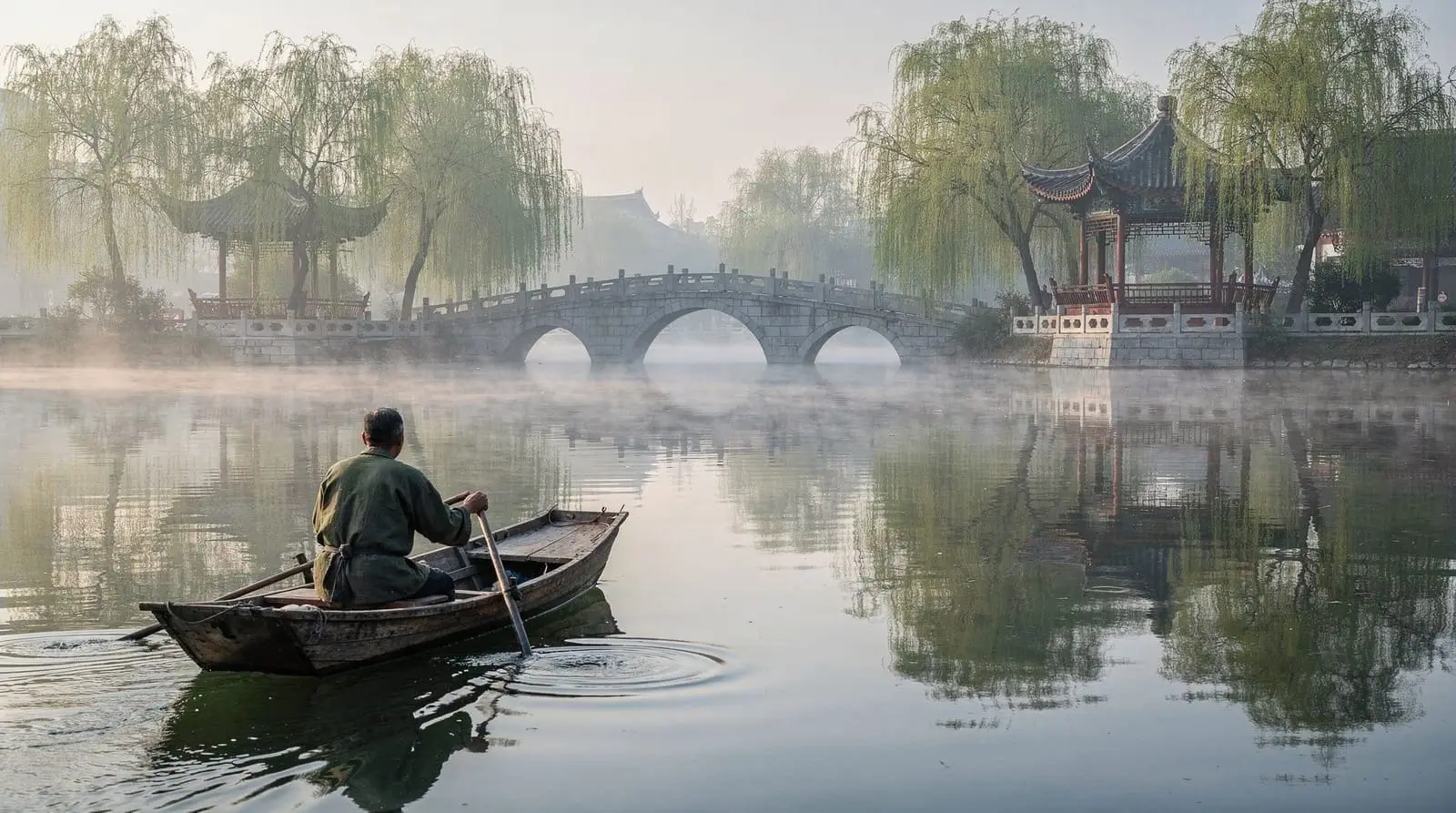
Huizhou sits at the northeastern edge of the Greater Bay Area, roughly equidistant between Shenzhen and the coast of the South China Sea. It’s not a destination with headline attractions — no theme parks, no UNESCO sites, no globally recognized landmarks. What it offers instead is the kind of slower, greener, lakeside Guangdong that existed before the Pearl River Delta became one of the world’s most densely industrialized corridors.
| Where | Northeast of Shenzhen, Pearl River Delta |
| Cost | Mostly free or ¥5–100 per site; seafood meal ¥80–150 |
| Time needed | 1 day trip from Shenzhen, or 1–2 nights |
| Getting there | HSR 35–45 min from Shenzhen North |
| Best time | October–April; West Lake plum blossoms in Feb–March |
The city’s defining feature is Huizhou West Lake (惠州西湖), a natural lake in the urban center with 2,000 years of cultural layering. Su Dongpo (Su Shi), the great Song-dynasty poet, was exiled to Huizhou in 1094 and wrote about the lake extensively, giving it an early literary reputation. The comparison to Hangzhou’s more famous West Lake is apt in character if not in scale. Beyond the lake, the Luofu Mountain sacred site north of the city offers genuine wilderness hiking and ancient Taoist temples, while the Daya Bay coastline to the southeast provides the best beaches accessible from Shenzhen by public transport.
Huizhou also serves a practical function for PRD travelers: as a lower-cost overnight base when Shenzhen accommodation prices spike during trade fairs or public holidays, and as a natural extension for visitors exploring Shenzhen’s eastern coast and Yantian.
Getting to Huizhou
From Shenzhen: HSR from Shenzhen North to Huizhou South takes 35–45 minutes (¥50–80 / $7–11). Trains run roughly hourly. From Huizhou South station, a Didi to the city center takes 20–25 minutes (¥35–50 / $4.90–$7). The station is in the southern new development area and is not walkable to the old city or West Lake.
Alternatively, from Shenzhen’s eastern Yantian or Dapeng areas, a coach runs directly to Huizhou bus terminal in 60–75 minutes (¥35–50 / $4.90–$7) — a useful option if you’re already exploring Shenzhen’s eastern coast.
From Guangzhou: HSR from Guangzhou East or Guangzhou to Huizhou: 75–90 minutes (¥60–100 / $8.40–$14). Multiple options throughout the day.
From Hong Kong: No direct HSR. Options: Bus from Hung Hom or Lo Wu to Huizhou bus terminal (2.5–3 hours, HK$120–180 / $15–23), or HSR to Shenzhen with a connection. The bus is often more direct if you’re coming from the Kowloon side of Hong Kong.
Within Huizhou: The city has limited metro coverage (two lines serving newer residential areas in 2026). Didi and local taxis are the reliable option for moving between West Lake, the old city, Luofu Mountain, and Daya Bay. Rides are inexpensive: ¥15–40 ($2.10–$5.60) across most of the urban area.
Huizhou West Lake
The West Lake (西湖) scenic area covers 10 square kilometers of lake, islands, and surrounding parkland within the urban center. Entry to the main park is free; certain pavilions and island crossings have nominal fees (¥5–15 / $0.70–$2.10). The lake is divided into five named sections connected by ancient stone bridges and causeways, several dating to the Song dynasty.
The most photogenic section is the Pinghu Autumn Moon (平湖秋月) area on the northeastern shore, where a Song-era pavilion complex extends into the water and evening lantern reflections are one of the lake’s characteristic images. Su Dongpo is credited with the lake’s early hydraulic engineering — the Su Causeway (苏堤) running north-south across the lake was ordered during his exile and is still the main pedestrian crossing. Along the causeways, willows and banyan trees overhang the water; in late February and early March, red plum blossoms are the highlight.
Practical West Lake visit: Arrive in the morning for the quietest conditions — local tai chi and walkers are here before 8 a.m. Afternoon heat (May–September) and weekend crowds make the lake less pleasant by 11 a.m. Electric boat rentals cost ¥60–100 ($8.40–$14) per 30 minutes. The lakeside restaurants are tourist-priced; eat in the Huizhou old town, 10 minutes’ walk north, for better value.
Su Dongpo Memorial Hall (苏东坡纪念馆) on the west shore commemorates the poet’s two periods of exile in Huizhou (1094–1097 and briefly 1101). The exhibition is modest but the location — beside the lake he wrote about — has a genuine literati atmosphere. Entry ¥5 ($0.70).
Luofu Mountain: Taoist sacred site
Luofu Mountain (罗浮山), 45 minutes north of Huizhou city by Didi (¥70–100 / $10–14), is a Taoist sacred mountain with temples dating from the Eastern Han dynasty and continuous religious activity since the 4th century CE. The mountain is most associated with Ge Hong (葛洪, 283–343 CE), one of the most influential Taoist alchemists in Chinese history, who lived and wrote his major pharmacological works here. His tomb and the Chongxu Ancient Temple (冲虚古观), established 328 CE, remain the spiritual center of the site.
The hiking trails through pine and subtropical forest to several summit temples are well-marked and take 4–6 hours for a full circuit. The highest accessible peak (Fei Yun Ding, 1,296 meters) offers views across the Pearl River Delta on clear days — which in Huizhou’s interior means autumn and winter mornings before haze builds. Entrance ¥80 ($11). A cable car (¥60 / $8.40 one-way) runs to the upper temple area for those not interested in the full ascent.
Practical Luofu: Weekdays are significantly quieter than weekends, when hiking crowds from Shenzhen and Guangzhou fill the main trails. Start before 9 a.m. to avoid the midday heat and have the temples nearly to yourself in the early morning light. There are simple vegetarian restaurants at the temple (the Taoist community maintains vegetarian cooking traditions) at ¥30–50 ($4.20–$7) for lunch.
Hakka cultural heritage
Huizhou Prefecture has historically been a center of Hakka (客家) culture — the Hakka being a Han Chinese group with distinct language, cuisine, and architectural traditions, who migrated south over several centuries to settle in Guangdong, Fujian, and Taiwan. The Huizhou area retains some of the most intact Hakka architecture in Guangdong Province.
Keliao Traditional Village (客家围屋): Several Hakka weilongwu (围龙屋) clan complexes survive in the rural areas 20–40 km from Huizhou city center. The weilongwu form — a horseshoe-shaped compound enclosing a clan hall, residential wings, and inner courtyard — is distinctively Hakka and found primarily in Guangdong and Taiwan. The Paiyi Keliao (排屋客家围) in Boluo County is the most intact example accessible by taxi from Huizhou (¥50–80 / $7–11, 35–45 minutes). No admission fee; local families still reside in parts of the compound. Handle the visit with consideration.
Hakka cuisine in Huizhou: The local eating tradition reflects Hakka preservation techniques developed for a historically itinerant people without fixed agricultural land. Cured pork with preserved vegetables (梅菜扣肉), salt-baked chicken (盐焗鸡), and braised pork belly with fermented tofu (豆腐乳炆猪肉) are standards. In the old town area around Shuimen Bridge, simple restaurants serve these at ¥20–40 ($2.80–$5.60) per dish. The Yidong Jiuguan (益东酒馆) on Shuimen Street is a local institution with reliable Hakka cooking; ¥60–100 ($8.40–$14) for two people.
Daya Bay and the coastline
Daya Bay (大亚湾) is a deep-water bay on the South China Sea coast, 30–40 minutes southeast of Huizhou city by Didi (¥60–90 / $8.40–$13). The bay’s relative depth and distance from heavy shipping keeps water clarity better than Pearl River estuary beaches near Shenzhen. Several beaches in the Aopo area are suitable for swimming from October through May.
The coastal villages at Aopo Town (澳畔) have fresh-catch seafood restaurants where you select your fish from tanks and pay by weight — ¥80–150 ($11–21) for two people with two fish dishes and vegetables. This is consistently cheaper than equivalent seafood in Shenzhen’s Yantian or Dapeng areas.
Shuangyuewan (双月湾, “Double Moon Bay”) in Huizhou’s Huidong County — 50 km east of the city center, 80 minutes by Didi (¥150–220 / $21–31 each way) — is the most visually dramatic beach in the area: two crescent bays facing each other on either side of a headland. Popular with Shenzhen and Guangzhou weekend visitors who find it worth the 2-hour drive. Water quality is best September–January.
Huizhou–Daya Bay Nuclear Power Station: The plant is visible from certain coastal points and provides a distinctive backdrop for photography if nuclear infrastructure is your aesthetic. Not an official viewing site; the surrounding exclusion zones limit close approach.
Huizhou’s food culture
Beyond Hakka preservation traditions, Huizhou’s cuisine reflects coastal influence from Daya Bay and the estuary.
Freshwater fish: Huizhou’s inland waterways supply fresh carp, tilapia, and mandarin fish to local markets. Steamed mandarin fish (桂鱼) with ginger and soy is the prestige dish (¥80–150 / $11–21 depending on size). In the old town, wet markets operating from 5 a.m. display the morning catch with prices 20–30% lower than Shenzhen for equivalent fish.
Meizhou-style taro duck (芋头鸭): Braised duck with taro in a soy-dark master stock, a Hakka specialty shared between Huizhou and Meizhou. Rich, slightly sweet, excellent with rice. ¥60–100 ($8.40–$14) for a half-duck serving two.
Huizhou old town area (惠城老街): The streets around Shuimen Bridge in the old city center have wet markets and a cluster of local rice-noodle shops and tea houses. An early morning walk here before 8 a.m. captures the city’s working rhythm most honestly.
Combining Huizhou with other destinations
With Shenzhen and Dapeng: If spending time in eastern Shenzhen — Dapeng Peninsula, Yantian — a Huizhou extension connects naturally eastward by coach or Didi along the coastal road. This is the best geographic pairing for Huizhou.
With Dongguan: Huizhou is 45 minutes west by HSR. A day combining Dongguan’s Songshan Lake with a Huizhou West Lake evening is feasible if you’re efficient with timing.
With the PRD loop: The Pearl River Delta Grand Loop itinerary includes Huizhou as the northeastern extension for travelers wanting to complete the circuit clockwise from Shenzhen through Dongguan and Guangzhou.
Budget overnight from Shenzhen: Huizhou accommodation runs ¥200–400 ($28–56) per night for mid-range hotels near West Lake — significantly below equivalent Shenzhen options during peak periods (Canton Fair months, National Day Golden Week). The HSR makes a return to Shenzhen in under 45 minutes when needed.
Practical information
Accommodation: Near West Lake: Huizhou Royal Hotel (¥450–700 / $63–98), Pullman Huizhou (¥650–950 / $91–133), and the long-standing Huizhou International Hotel (¥350–550 / $49–77). Budget options in the old town area start at ¥180–300 ($25–42) at Chinese business hotels.
Internet: The Great Firewall applies fully. Install your VPN before crossing from Hong Kong. See the eSIM and VPN in China guide for setup, and the WeChat Pay and Alipay for foreigners guide since Huizhou’s smaller businesses lean even more heavily on mobile payment than Shenzhen, with less card acceptance as a fallback.
Language and safety: Cantonese and Hakka dialects are both common, with Mandarin as the shared official language; English is minimal outside the West Lake hotel area. Huizhou is safe for tourists by the same standards as the rest of the Pearl River Delta — the main practical friction is language rather than any elevated risk. Carry the address of your accommodation in Chinese characters, since Didi drivers and taxi drivers outside the HSR station area rarely navigate from English addresses alone.
Weather: Subtropical with hot, humid summers (June–September, real typhoon risk) and mild, dry winters (December–February, 10–18°C). October to April is comfortable for walking West Lake and hiking Luofu Mountain; midsummer heat makes the mountain’s full circuit considerably more demanding and the lake’s shadeless causeways uncomfortable by late morning.
Honest assessment: Huizhou is not a place most travelers should plan a dedicated multi-day visit around. Its appeal is specific: natural scenery, Hakka culture, and coastal relief from the PRD’s urban intensity. If those don’t match your interest, the time is better spent extending your stay in Guangzhou or adding a day to Zhuhai.
For travelers who find the PRD’s relentless commercial energy exhausting after several days, Huizhou’s West Lake parks and Luofu Mountain provide a genuine reset — and the HSR back to Shenzhen takes less than 45 minutes.
Huizhou vs. Dapeng Peninsula: which nature day trip to pick
Shenzhen visitors often have to choose between Huizhou and Dapeng Peninsula for their single “nature day” — both are roughly 90 minutes from central Shenzhen and both offer a genuine break from the city.
| Huizhou | Dapeng Peninsula | |
|---|---|---|
| Character | Lake, temples, Hakka villages | Beaches, coastal hiking |
| Best for | History, culture, temples | Swimming, seafood, beach days |
| Getting there | HSR 35–45 min | Metro + bus, 90–100 min |
| Beach quality | Daya Bay, decent but a further detour | Xichong Beach, Shenzhen’s best |
| Pick this if… | You want temples and lake scenery | You want sand, sea, and hiking |
Both pair naturally with Yantian district if you’re building a longer eastern Guangdong loop rather than choosing just one.
A full day in Huizhou: suggested structure
A realistic day trip from Shenzhen, departing on the 08:00 HSR and returning by 18:00:
08:00 — HSR from Shenzhen North. Arrive Huizhou South ~08:45.
09:00–10:30 — West Lake: Su Causeway walk, Pinghu Autumn Moon pavilion, Su Dongpo Memorial Hall. This is the best time — locals are finishing their morning exercise routines and the tea houses around the north gate are still serving breakfast.
10:30–12:00 — Walk from West Lake north gate to the old town around Shuimen Bridge. Browse the morning wet market (winding down by 11:00), then breakfast/brunch at a local rice-noodle shop (¥15–25 / $2.10–$3.50 per person).
12:30 — Didi to Luofu Mountain entrance (45 minutes, ¥70–100 / $10–14). Enter by 13:00.
13:00–16:00 — Luofu Mountain: take the cable car up (¥60 / $8.40 one-way), visit Chongxu Ancient Temple, walk the mid-level trail connecting two temple complexes (45 minutes), descend via trail (60 minutes) or cable car for the return.
16:30 — Didi back to Huizhou South station (45 minutes, ¥70–100 / $10–14).
17:15 — HSR to Shenzhen North (40 minutes). Arrive 17:55 for dinner in Shenzhen.
This day is satisfying rather than exhausting. The West Lake visit in the morning is genuinely beautiful; Luofu Mountain in the afternoon provides a different register entirely — sacred history rather than lakeside culture. The combination makes Huizhou feel coherent as a destination rather than a single-attraction trip.
Huizhou’s history as a cultural crossroads
Huizhou Prefecture’s historical position at the meeting of Cantonese, Hakka, and Teochew cultural zones makes it an interesting lens on how these distinct southern Chinese identities formed in close proximity.
Cantonese settlers along the coastal areas and river channels near the Pearl River delta built the fishing villages that still define Daya Bay’s coastal character. Their cooking tradition — seafood-focused, freshwater fish emphasis, light saucing — is the dominant food culture in Huizhou’s coastal areas.
Hakka settlers in the hillier interior established the weilongwu clan compounds and developed the preservation-based cooking tradition (cured meats, fermented tofu, salt-baking techniques) that evolved because of their historically itinerant status. The interior Huizhou districts, particularly Huidong and Boluo counties, are Hakka-majority.
Teochew (Chaoshan) influences are lighter in Huizhou proper than in neighboring Dongguan, but the marinated goose (卤鹅) and cold-brew gongfu tea practices appear in the eastern coastal areas where Teochew traders historically operated.
This cultural layering is why Huizhou’s food scene is more diverse than a city of its size and prominence typically is. The Hakka-Cantonese combination in particular produces a local cuisine that is serious about both preserved meats and fresh seafood in ways that neither tradition alone fully explains.
Huizhou for families with children
For parents traveling the PRD with young children, Huizhou offers several options that are meaningfully less overwhelming than the major theme parks:
West Lake paddle boats: Electric paddle boats on West Lake (¥50–80 / $7–11 per 30 minutes) are gentle and appropriate for children over 4. The lake’s divided sections mean different environments within a short boat ride.
Luofu Mountain cable car: Children find the cable car and temple complex at the summit genuinely engaging without the crowd pressure of Chimelong Ocean Kingdom. The mountain has wildlife — Chinese pangolins and various bird species — and the subtropical forest is lush year-round.
Butterfly Valley (蝶谷奇境) in the Boluo County hills: A butterfly sanctuary and insect ecology museum that works well for the 4–10 age group. Entry ¥60 ($8.40) adults, ¥30 ($4.20) children. 50 minutes from Huizhou city by Didi.
For comparison: Zhuhai’s Chimelong is the most impressive theme park option in the region; Hong Kong’s Ocean Park and Disneyland are the premium international family options. Huizhou is not in the same category for theme park scale, but provides more authentic natural encounters.
Nature hiking and cycling in the Huizhou area
Beyond Luofu Mountain, the Huizhou region has developed a modest outdoor recreation infrastructure that attracts weekend hikers from Shenzhen and Guangzhou:
Nankunshan National Forest Park (南昆山国家森林公园): 80 km north of Huizhou city, accessible by intercity bus (2 hours, ¥40–60 / $5.60–$8.40). The park covers 7,000 hectares of subtropical montane forest with waterfalls, suspension bridges, and camping sites. Temperatures are 8–12°C cooler than the coastal plain in summer. A popular overnight destination for Shenzhen and Guangzhou residents escaping summer heat.
Huidong coastline cycling: The coastal road between Aopo and Shuangyuewan has been developed as a cycling route with dedicated lanes for about 20 km of the most scenic coastal section. Bicycle rental is available at both ends (¥50–80 / $7–11 per day). The views across Daya Bay toward the open South China Sea are the best panoramic coastal views accessible from the Greater Bay Area without taking a ferry.
Xunliao Bay (巽寮湾): 90 km southeast of Huizhou city on the coast of Huidong County, Xunliao Bay has become the most developed beach resort area accessible from Shenzhen by road (2 hours). Several mid-range resort hotels (¥500–1,200 / $70–168 per night) operate here with private beach access. Water quality is consistently rated among the best on the Guangdong coast.
Huizhou as an overnight extension from Shenzhen
For visitors with more flexible time, staying one or two nights in Huizhou rather than doing it as a rushed day trip changes the character of the visit considerably. An overnight allows an early-morning West Lake walk before the day-trippers arrive (genuinely one of the best hours anywhere in the PRD for a quiet lakeside walk), a full unhurried day at Luofu Mountain without the pressure of an HSR return time, and the option of adding Daya Bay or Xunliao Bay as a second day rather than skipping the coast entirely.
Budget travelers building a longer Pearl River Delta trip sometimes use Huizhou as a deliberate lower-cost base during periods when Shenzhen hotel prices spike — Golden Week, Canton Fair overlap, and Chinese New Year all inflate Shenzhen and Guangzhou rates disproportionately more than Huizhou’s. The HSR connection back to Shenzhen in under 45 minutes makes this a genuinely practical strategy rather than a compromise, provided you don’t mind the daily commute for a few days.
If Huizhou is your first stop on a clockwise Pearl River Delta loop, it also sets a useful expectation baseline: quieter, greener, and slower than what follows at Dongguan, Guangzhou, and eventually Shenzhen or Hong Kong — a gentle introduction before the density picks up, and one that many first-time PRD visitors say they wish they’d scheduled with more time rather than less, especially once they’ve experienced the pace difference firsthand.